Full analysis selected. Choose Quick brief to read the key points first.
WFN QUICK BRIEF · UNDER 1 MIN
The short version
MODE 2 OF 2
What the primary record establishes
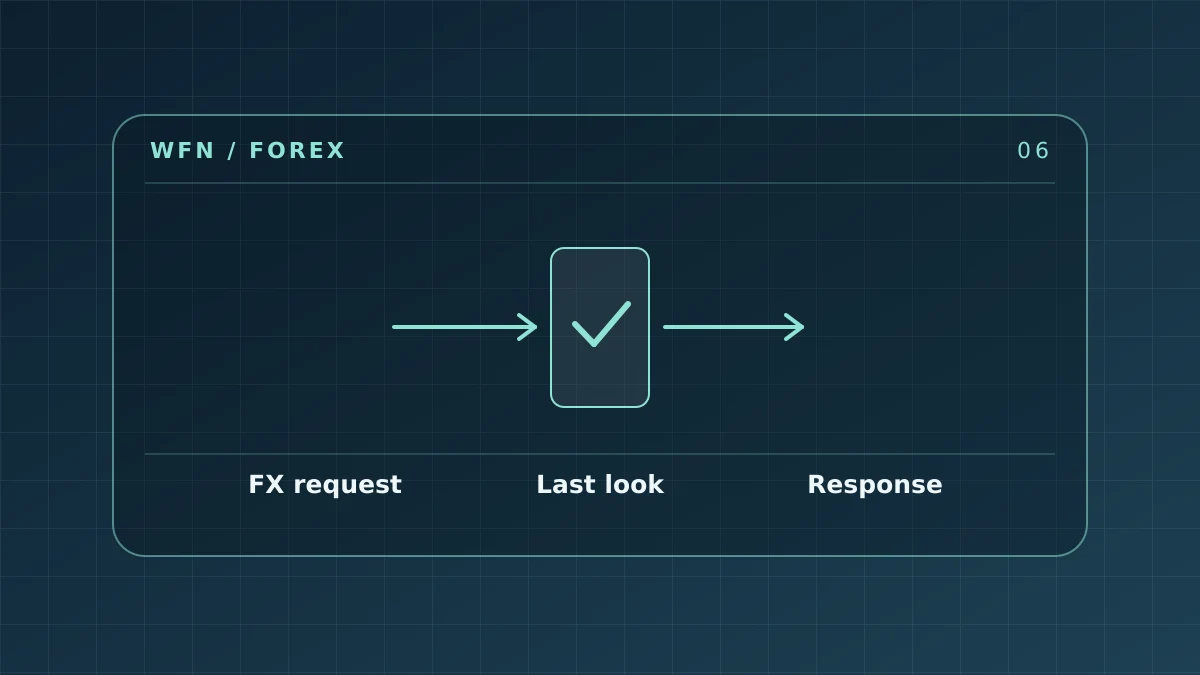
The FX Global Code describes last look as a check on price and request validity before acceptance. Principle 17 calls for transparency about its use. An execution review needs the full population of requests sent to the liquidity provider and their outcomes. FX Global Code, Principle 17 ↗
What the distinction changes
Suppose a client requests EUR/USD at 1.0800 and sees a rejection 25 milliseconds later. A chart alone cannot establish the reason. Useful records include request and response times, direction, size, stream ID and any rejection code. Clock misalignment can misattribute delay.
What to check before drawing a conclusion
Compare rejection rates and response times for similar requests, grouping by currency pair, size and market conditions. Store both the side of the trade and the direction of the intervening price move. That makes any asymmetry testable against the provider’s disclosures and messages.
Quick Brief is a reading aid. The full article and source trail stay on this page.
WFN STORY COMPASS
Choose your reading angle
Switch between the reported record, market context and open questions. Status labels distinguish claims from findings.
All context layers are visible. Choose a lens to jump to that part of the story.
Original WFN vector illustrationWFN · 6 November 2026
Editorial noteSource-based explanation with original WFN analysis. Historical records retain their dates; numerical examples are illustrative. The original vector illustration is conceptual and is not documentary evidence.
WFN REALITY LEDGER
What is on the record?
Primary-source explainer
Primary-source explainer
Primary record / reference periodFX Global Code, Principle 17
The linked source supports the documented record; WFN interpretation and illustrative examples are separate.
01 · VERIFIED RECORD
What the primary record establishes
The FX Global Code describes last look as a check on price and request validity before acceptance. Principle 17 calls for transparency about its use. An execution review needs the full population of requests sent to the liquidity provider and their outcomes. FX Global Code, Principle 17 ↗
02 · WFN EDITORIAL ANALYSIS
What the distinction changes
Suppose a client requests EUR/USD at 1.0800 and sees a rejection 25 milliseconds later. A chart alone cannot establish the reason. Useful records include request and response times, direction, size, stream ID and any rejection code. Clock misalignment can misattribute delay.
03 · REVIEW POINTS
What to check before drawing a conclusion
Compare rejection rates and response times for similar requests, grouping by currency pair, size and market conditions. Store both the side of the trade and the direction of the intervening price move. That makes any asymmetry testable against the provider’s disclosures and messages.