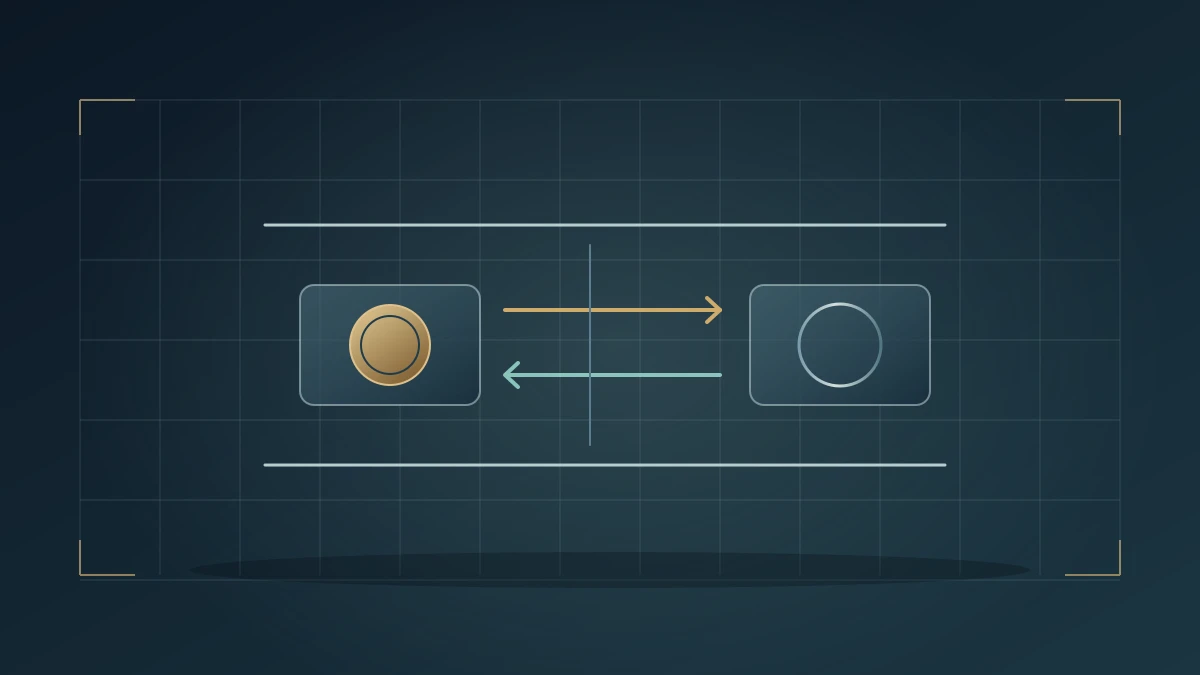
Hong Kong's Linked Exchange Rate System connects the currency market with the supply of Hong Kong dollar liquidity. The Hong Kong Monetary Authority describes a convertibility zone of HK$7.75–7.85 per US dollar within its Currency Board framework. The system has operated since 17 October 1983, although that historical starting date should not be read as the introduction date of every current feature. HKMA — Linked Exchange Rate System ↗
Follow the direction of the transaction
Understanding the mechanics helps explain why a narrow exchange-rate band can coexist with changing local funding conditions.
Under the strong-side undertaking at 7.75, the HKMA buys US dollars from licensed banks and supplies Hong Kong dollars. Under the weak-side undertaking at 7.85, it sells US dollars and takes in Hong Kong dollars. These directions matter: the same phrase, currency support, can conceal opposite changes in the domestic monetary base. HKMA — How Does the LERS Work? ↗
The undertakings concern eligible banks' transactions with the HKMA. They do not establish a fee-free retail conversion service for every customer or guarantee that a broker's displayed spread will equal the distance between the zone's boundaries.
An illustrative USD100 million transaction at the weak-side rate corresponds to HK$785 million. That multiplication describes the gross currency amounts. To explain what actually happened to banking-system balances on a particular date, a report still needs the HKMA's published operation and liquidity records.
The Aggregate Balance carries the funding adjustment
In a commentary dated 6 October 2026, HKMA Chief Executive Eddie Yue explained that a persistent Hong Kong dollar–US dollar interest-rate differential could encourage further Hong Kong dollar weakness. If the weak-side undertaking were triggered, he wrote, the Aggregate Balance would decrease, pushing up Hong Kong dollar interest rates and supporting exchange-rate stability within the zone. He presented the possible trigger conditionally rather than announcing that it had already occurred. HKMA — Recent trend in the Hong Kong dollar; 6 October 2026 ↗
This account supplies a mechanism for analysis: currency conversion changes Hong Kong dollar liquidity, and liquidity conditions influence local interest rates. A responsible description should preserve both links. Reporting a possible tightening of funding as an already executed intervention would change the meaning of the statement.
Read the currency and funding records together
For a practical market review, record the observed USD/HKD quote and its timestamp, then identify any confirmed convertibility transaction and the associated published liquidity information. Interest-rate observations should specify their tenor and date. An overnight rate and a three-month rate describe different funding periods.
The October commentary also identified capital-market activity, carry-trade appetite and seasonal liquidity demand among relevant influences. Those were explanations of the environment, rather than a precise timetable for the next undertaking transaction. HKMA — Recent trend in the Hong Kong dollar; 6 October 2026 ↗
The framework gives readers a way to organise evidence without treating the exchange-rate boundaries as a complete trading model. Currency risk, funding cost, execution price and the terms of a particular account remain distinct inputs to any decision.