Full analysis is selected. Choose Quick brief to scan the key points first.
WFN QUICK BRIEF · UNDER 1 MIN
The short version
MODE 2 OF 2
The record
On 19 March 2020, the Federal Reserve announced temporary dollar liquidity arrangements with nine central banks, including those of Australia, Brazil, Denmark, South Korea, Mexico, Norway, New Zealand, Singapore and Sweden. The stated purpose was to help ease strains in global dollar funding markets. Federal Reserve temporary swap-line announcement ↗
WFN analysis
Funding demand and directional currency demand can appear in the same market but answer different questions. An institution can need dollars to meet liabilities without expressing a long-term view that the dollar should appreciate.
Next check
For the 2020 episode, compare the announcement with contemporaneous dollar funding indicators and published facility usage. An available arrangement is not the same as an actual drawdown. For present-day coverage, verify which arrangements remain active instead of carrying the historical list forward as a current access map. Record facility limits and usage separately.
Quick Brief is a reading aid. The full article and source trail stay on this page.
WFN STORY COMPASS
Choose your reading angle
Move between the reported record, market context and open questions. Status labels keep claims distinct from findings.
All context layers are visible. Choose a lens to jump to that part of the story.
MARKET CONTEXTWFN EDITION · 14 OCTOBER 2026
Editorial noteSource-based explanation with original WFN analysis. Historical records retain their dates. Original WFN editorial diagram; it is not a live market chart.
WFN REALITY LEDGER
What is on the record?
Primary-source analysis
Dated official record / historical or technical explainer
The cited record establishes the documented event. Proposals, technical announcements, allegations and orders retain their stated status; WFN Analysis is editorial interpretation.
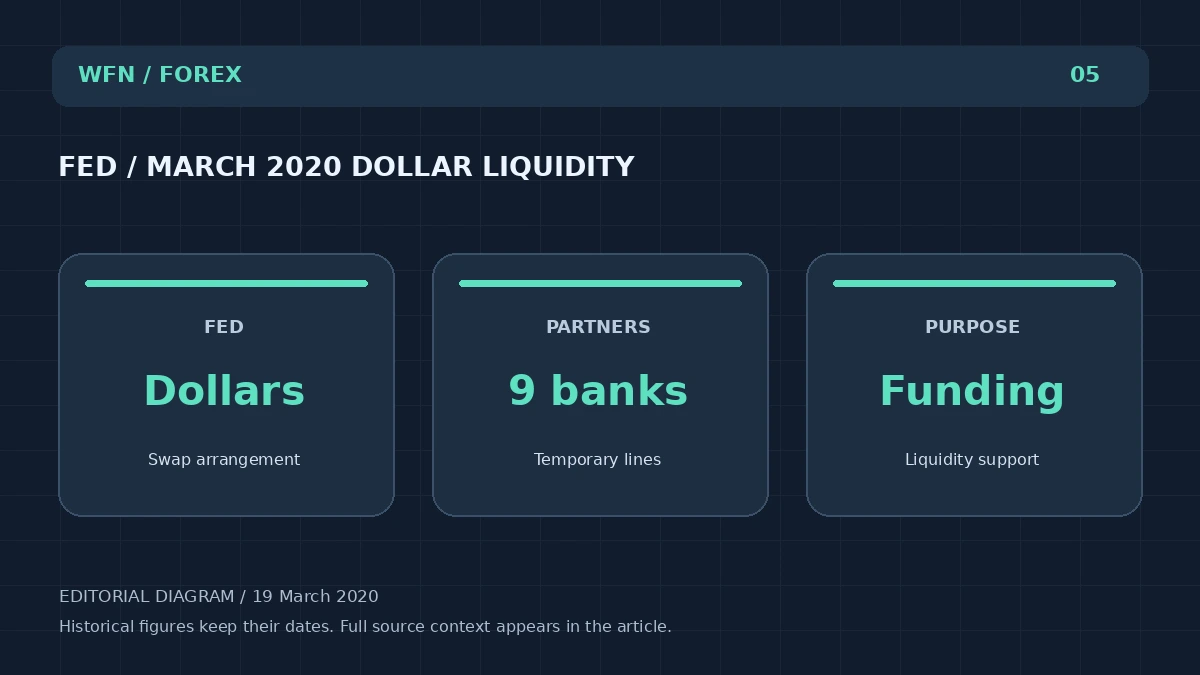
Nine temporary central-bank swap arrangements announced in March 2020 illustrate how dollar liquidity support differs from an FX-rate target.
01 · VERIFIED RECORD
The verified record
On 19 March 2020, the Federal Reserve announced temporary dollar liquidity arrangements with nine central banks, including those of Australia, Brazil, Denmark, South Korea, Mexico, Norway, New Zealand, Singapore and Sweden. The stated purpose was to help ease strains in global dollar funding markets. Federal Reserve temporary swap-line announcement ↗
The announcement described access to dollar liquidity through central-bank arrangements. It was not an announcement of a target level for a dollar exchange rate.
02 · WFN EDITORIAL ANALYSIS
Why it matters
Funding demand and directional currency demand can appear in the same market but answer different questions. An institution can need dollars to meet liabilities without expressing a long-term view that the dollar should appreciate.
That distinction changes the evidence an analyst should seek. A claim about funding stress calls for funding-market observations; a claim about an exchange-rate outlook calls for a broader set of valuation and policy evidence. One cannot substitute for the other simply because both use the word dollar.
03 · WHAT TO CHECK NEXT
What to check next
For the 2020 episode, compare the announcement with contemporaneous dollar funding indicators and published facility usage. An available arrangement is not the same as an actual drawdown. For present-day coverage, verify which arrangements remain active instead of carrying the historical list forward as a current access map. Record facility limits and usage separately.