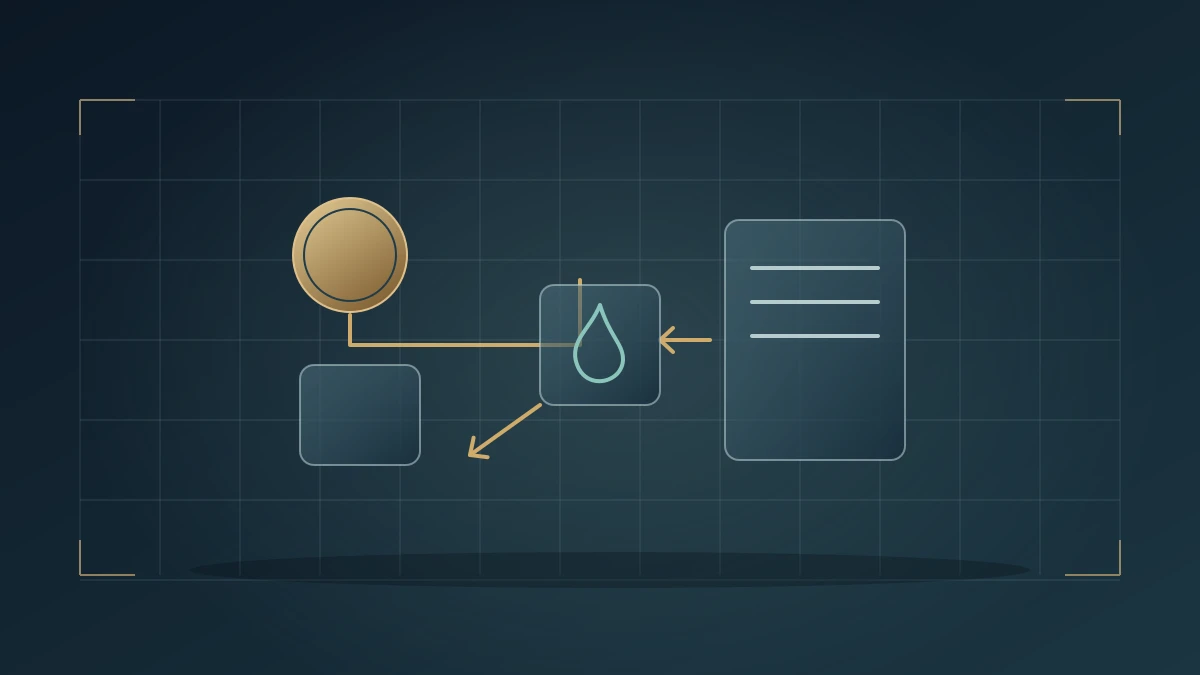
A wallet can let a customer complete an on-chain action without first acquiring the network's native gas asset. ERC-4337 supports this through paymasters: contracts that agree to cover gas costs for eligible user operations. The network cost still exists, while the application can change who funds it and how the customer experiences the charge. Ethereum Improvement Proposals — ERC-4337: Account Abstraction Using Alt Mempool ↗ERC-4337 documentation — Paymasters ↗
Follow the user operation through the funding checks
For payment and brokerage integrations, the economic terms of that sponsorship deserve the same attention as the simplified checkout screen.
ERC-4337 describes a UserOperation processed through an EntryPoint contract, with bundlers collecting operations for submission. When a paymaster is involved, the validation flow checks its willingness to sponsor the operation and the availability of a sufficient deposit to cover the relevant gas cost. Ethereum Improvement Proposals — ERC-4337: Account Abstraction Using Alt Mempool ↗
That funding dependency has a practical consequence. A user can have a correctly configured wallet and a valid intended action while the proposed sponsorship is unavailable. The system needs a way to explain which part failed: account authorisation, application execution or the arrangement for paying the network cost.
The standard distinguishes the deposit used for gas charges from a stake that may be required in connection with paymaster behaviour. Treating every amount held by the paymaster as spendable sponsorship funds would misstate the available budget. Ethereum Improvement Proposals — ERC-4337: Account Abstraction Using Alt Mempool ↗
Sponsorship can carry application conditions
The ERC-4337 documentation describes paymasters that subsidise users, support token-based fee payment or restrict eligibility using application logic. Different designs can therefore produce different commercial arrangements beneath similar gas-free wording. ERC-4337 documentation — Paymasters ↗ERC-4337 documentation — Types of Paymasters ↗
Consider an illustrative service offering 100 sponsored actions per customer per month. Its user experience needs to explain what happens at action 101, whether failed application executions count toward the allowance and whether the service can withdraw the offer. Those are policy questions for the operator; the standard's existence does not answer them automatically.
If a customer is charged in a token, the review also needs the quoted token amount and any conversion or service charge used by that implementation. A sponsored native-currency gas payment alone does not establish the customer's complete economic cost.
Failure still has a funding consequence
ERC-4337 includes a post-operation state for an application execution that reverted while the paymaster still pays for gas. A sponsorship budget therefore cannot safely be calculated using successful application actions alone. Ethereum Improvement Proposals — ERC-4337: Account Abstraction Using Alt Mempool ↗
An operational record can keep the user-operation identifier, bundler transaction reference, EntryPoint and paymaster versions, funding decision, final execution state and actual recorded charge together. That makes it possible to reconcile what the network consumed with what the service promised the user.
The specific contracts and versions remain important because ERC-4337 infrastructure evolves. A generic claim of account-abstraction support leaves the production route unidentified. A documented route, explicit eligibility rules and a visible fallback when sponsorship is unavailable make the feature easier for customers to understand and for operators to maintain.