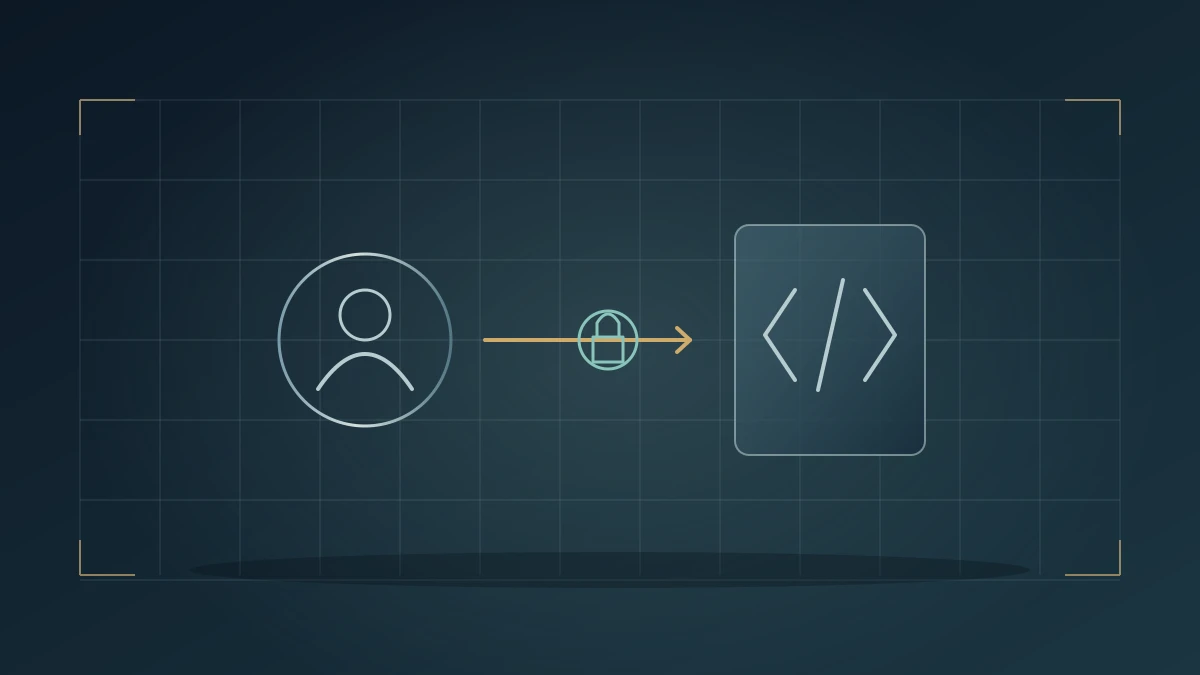
Ethereum's EIP-7702 gives an externally owned account a way to use code deployed at another address. Its applications include batching actions and arranging sponsored transactions. For a wallet user, the consequential part is the authority created when the account adopts that code, including what remains after the first interaction has finished. Ethereum Improvement Proposals — EIP-7702: Set Code for EOAs ↗
Identify the code receiving delegation
The proposal's motivation and its permission effects belong in the same explanation. A smoother interface can simplify an operation while making a careful account-level approval more important.
The standard defines an authorisation containing a chain identifier, a delegation address, an account nonce and signature components. Once valid authorisation is processed, the account stores a delegation indicator pointing to the selected code. Execution then follows that pointer in the context of the authorising account. Ethereum Improvement Proposals — EIP-7702: Set Code for EOAs ↗
That means an approval screen should make the delegation target understandable. A service name or familiar logo is inadequate evidence of what a particular address will execute. The user needs a connection between the displayed request, the actual code address and the wallet's explanation of its powers.
Ethereum's published guidelines warn that malicious delegated code can put account assets at risk. They also discuss initialization security and storage left behind when delegation changes. These are implementation concerns with direct consequences for the person authorising the account change. ethereum.org — Pectra EIP-7702 guidelines ↗
Persistence changes the review
EIP-7702 delegation persists beyond a single transaction. The specification further states that processed delegation indicators are not rolled back merely because the transaction's execution fails. A failed interaction therefore does not by itself establish that the account returned to its earlier configuration. Clearing a delegation involves a valid authorisation to the zero address under the standard's rules. Ethereum Improvement Proposals — EIP-7702: Set Code for EOAs ↗
Consider an illustrative wallet interaction that delegates an account and then attempts a swap. If the swap fails, a portfolio screen may show no completed trade. That observation alone leaves a separate question unresolved: which code now governs delegated execution? A useful activity log records the account change and the swap result as different events.
Check chain scope and recovery information
The chain identifier in the authorisation can specify the current chain or use zero. The latter makes the authorisation eligible across chains under the standard's validation rules; it does not mean a transaction has already been executed on every network. Wallet explanations should preserve that distinction. Ethereum Improvement Proposals — EIP-7702: Set Code for EOAs ↗
The ethereum.org guidelines recommend clearly displaying the contract receiving delegation and highlight phishing risks. A review can consequently start with the network, delegation address, requested capabilities and the wallet's documented method for inspecting or changing delegation. ethereum.org — Pectra EIP-7702 guidelines ↗
For a business integrating these wallets, customer support needs to distinguish a transaction failure from a persistent account-configuration change. Preserving the original request and its resulting on-chain state gives the team something concrete to investigate. The relevant evidence is the account's actual delegation and the code it points to, rather than the success message of an unrelated application action.