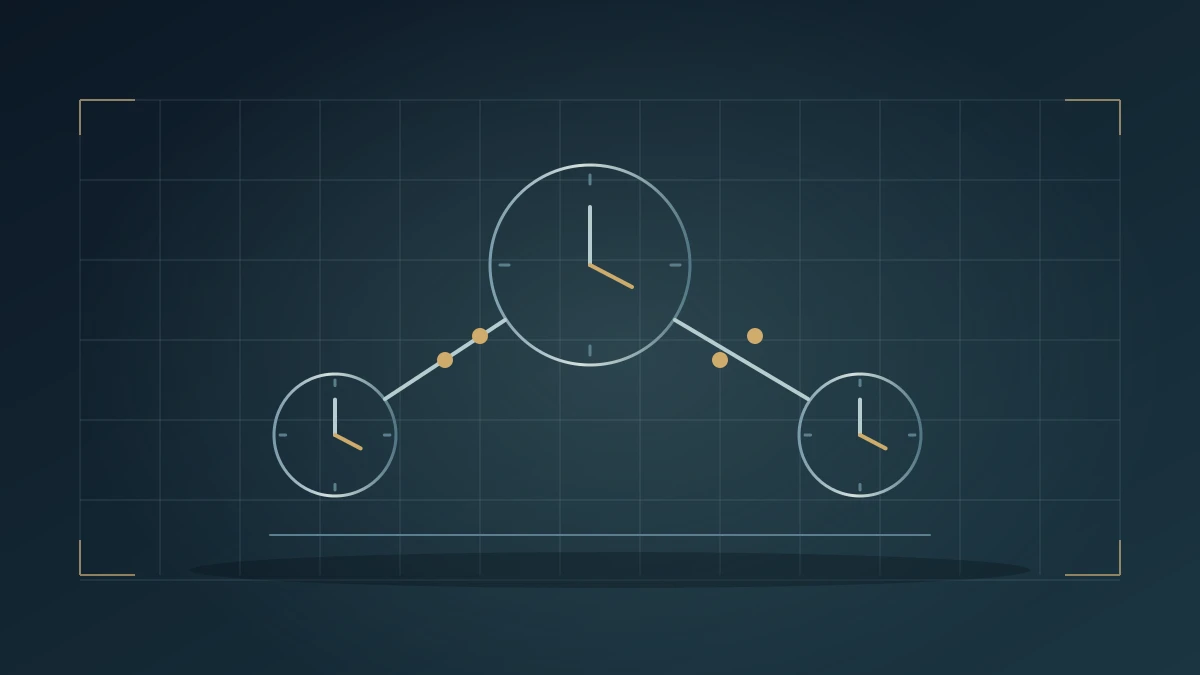
An order investigation often starts with timestamps: when a customer submitted an instruction, when the broker routed it and when an execution arrived. Those timestamps are useful only when the clocks behind them can be compared. FINRA Rule 4590 supplies a concrete synchronization requirement for its member firms and identifies the sources of timing error that count toward it. FINRA — Rule 4590: Synchronization of Member Business Clocks ↗
Count the complete path to the reference clock
The rule is part of the US securities framework. Its numerical tolerances should not be presented as a universal requirement for every forex broker, crypto venue or overseas trading system.
Rule 4590 specifies a 50-millisecond tolerance relative to the NIST clock for computer systems recording events in NMS securities, including standardized options, and OTC equity securities. It also describes a one-second tolerance for other covered business clocks. The tighter tolerance includes the time provider's error, transmission delay and the firm's own clock drift. FINRA — Rule 4590: Synchronization of Member Business Clocks ↗
That last detail makes the requirement an end-to-end question. A server can agree with its selected time source while the source itself is offset or its delivery path adds a meaningful error. A local synchronization indicator does not, by itself, reconstruct the total distance from the designated reference.
FINRA's July 2016 notice explained the move from the former one-second tolerance to the tighter computer-clock requirement and the accompanying implementation arrangements. It is a historical explanation of the change; the current rule text supplies the requirement being discussed here. FINRA — Regulatory Notice 16-23; 7 July 2016 ↗
Millisecond precision can conceal ordering uncertainty
Consider an illustrative record in which system A is 35 milliseconds fast and system B is 35 milliseconds slow. Both offsets are smaller than 50 milliseconds, yet the systems can differ by 70 milliseconds. An event timestamped on A and another on B therefore need careful comparison before a reviewer concludes which happened first.
The calculation does not interpret any particular firm's compliance. It shows why printing more decimal places is different from proving a corresponding degree of accuracy. The record needs knowledge of its time source and uncertainty, alongside its formatting precision.
Preserve synchronization evidence with the event trail
The rule calls for synchronization before market open and checks and re-synchronization as necessary through the day. Its supplementary material also requires documented procedures and synchronization logs, including notice of drift beyond the applicable tolerance. FINRA — Rule 4590: Synchronization of Member Business Clocks ↗
A practical incident record can connect those logs with the servers, applications and order events under review. If an operating system corrected its clock during the relevant period, preserving that correction helps explain an apparent gap or reversal in the application timeline.
For a brokerage, a useful reconstruction combines timestamps with order identifiers, execution references and the state transitions recorded by each component. Reliable time supports that chain of evidence. It does not replace the identifiers or the underlying business events, and a chronology should state any uncertainty that remains when observations came from different systems.