Full analysis is selected. Choose Quick brief to scan the key points first.
WFN QUICK BRIEF · UNDER 1 MIN
The short version
MODE 2 OF 2
The record
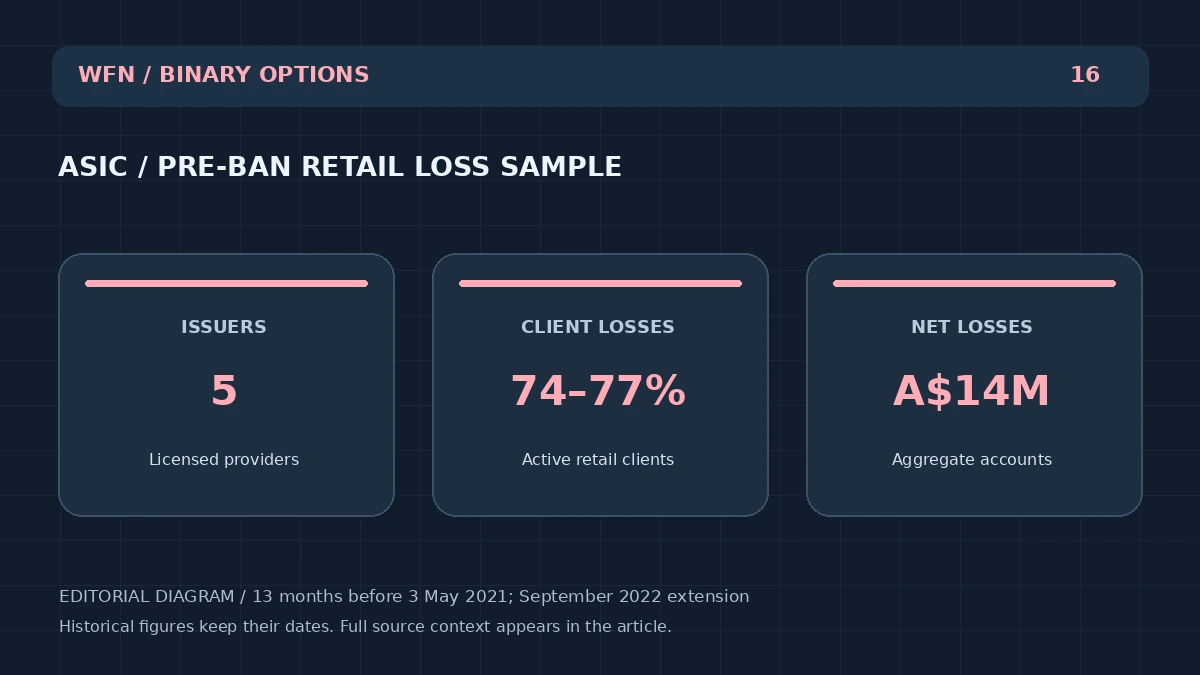
In its 5 September 2022 release, ASIC announced an extension of its retail binary-options product intervention order until 1 October 2031. Its analysis used data from five licensed issuers. For the 13 months before the ban took effect on 3 May 2021, ASIC reported that 74–77% of active retail clients lost money and aggregate retail account net losses were A$14 million. ASIC media release 22-243MR ↗
WFN analysis
A percentage becomes more informative when the denominator is visible. Active clients differ from all registered users, while a client-level measure can differ from an account-level measure. Editors should preserve those distinctions rather than replacing them with a broad claim about traders.
Next check
Before using the data in a comparison, check whether the other sample uses matching periods and definitions. For current availability, verify the actual jurisdiction and product-intervention instrument. Rebranding an offer as a prediction service does not establish its legal classification; the terms and applicable rules still need examination.
Quick Brief is a reading aid. The full article and source trail stay on this page.
WFN STORY COMPASS
Choose your reading angle
Move between the reported record, market context and open questions. Status labels keep claims distinct from findings.
All context layers are visible. Choose a lens to jump to that part of the story.
MARKET CONTEXTWFN EDITION · 14 OCTOBER 2026
Editorial noteSource-based explanation with original WFN analysis. Historical records retain their dates. Original WFN editorial diagram; it is not a live market chart.
WFN REALITY LEDGER
What is on the record?
Primary-source analysis
Dated official record / historical or technical explainer
Primary record / reference period13 months before 3 May 2021; September 2022 extension
The cited record establishes the documented event. Proposals, technical announcements, allegations and orders retain their stated status; WFN Analysis is editorial interpretation.
ASIC found that 74–77% of active retail clients in its pre-ban analysis lost money. The period and sampled issuers are part of that finding.
01 · VERIFIED RECORD
The verified record
In its 5 September 2022 release, ASIC announced an extension of its retail binary-options product intervention order until 1 October 2031. Its analysis used data from five licensed issuers. For the 13 months before the ban took effect on 3 May 2021, ASIC reported that 74–77% of active retail clients lost money and aggregate retail account net losses were A$14 million. ASIC media release 22-243MR ↗
The figures describe a defined Australian sample and historical period. They are not a measured loss rate for every binary product worldwide.
02 · WFN EDITORIAL ANALYSIS
Why it matters
A percentage becomes more informative when the denominator is visible. Active clients differ from all registered users, while a client-level measure can differ from an account-level measure. Editors should preserve those distinctions rather than replacing them with a broad claim about traders.
The same discipline applies to aggregate losses. A total can show the scale of an outcome without revealing each person’s experience. It cannot establish the probability that a new customer will lose a particular amount or prove that all platforms produce identical results.
03 · WHAT TO CHECK NEXT
What to check next
Before using the data in a comparison, check whether the other sample uses matching periods and definitions. For current availability, verify the actual jurisdiction and product-intervention instrument. Rebranding an offer as a prediction service does not establish its legal classification; the terms and applicable rules still need examination.