



Lunar Economy and Forex Markets: Why Artemis II Matters for Global Investors
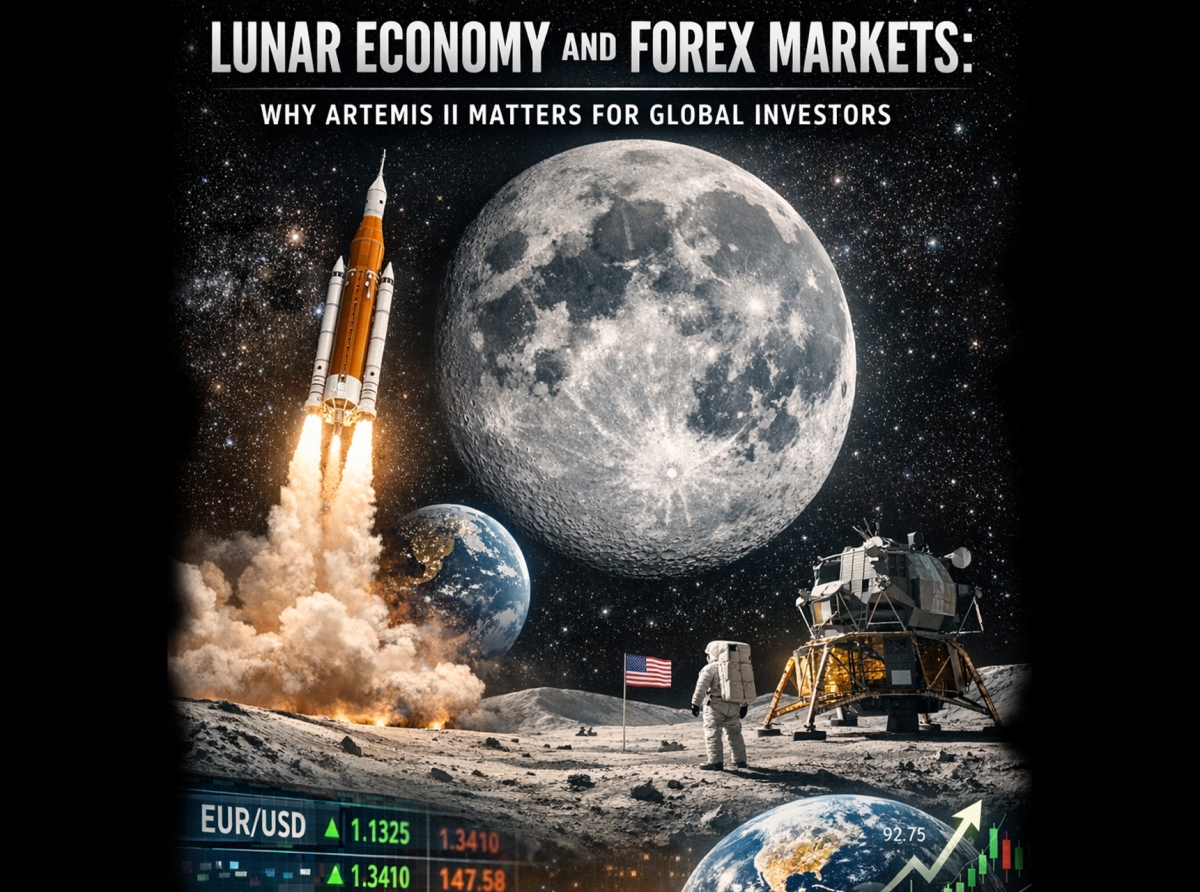
Lunar Economy and Forex Markets: Why Artemis II Matters for Global Investors
Artemis II signals a shift from symbolic space exploration to a resource-driven lunar economy, with implications for commodities, currencies, and long-term investment strategies across the global financial system.
The flag was planted back in 1969, but today the conversation has shifted from symbolism to infrastructure. With Artemis II, NASA is not just revisiting the Moon — it is testing the foundation of a future off-Earth economy. According to NASA (USA), the mission is scheduled no earlier than April 1, 2026, with a crewed lunar flyby lasting approximately 10 days. This timeline, while technical, has already begun influencing market narratives around innovation cycles, defense spending, and strategic commodities.
From a financial perspective, the Moon is no longer a historical milestone. It is becoming a strategic asset class. Investors tracking long-term macro trends are beginning to interpret lunar missions as signals of capital allocation shifts, particularly in the United States, China, and the European Union.
The flag was planted back in 1969, but today the conversation has shifted from symbolism to infrastructure. With Artemis II, NASA is not just revisiting the Moon — it is testing the foundation of a future off-Earth economy. According to NASA (USA), the mission is scheduled no earlier than April 1, 2026, with a crewed lunar flyby lasting approximately 10 days. This timeline, while technical, has already begun influencing market narratives around innovation cycles, defense spending, and strategic commodities.
From a financial perspective, the Moon is no longer a historical milestone. It is becoming a strategic asset class. Investors tracking long-term macro trends are beginning to interpret lunar missions as signals of capital allocation shifts, particularly in the United States, China, and the European Union.
Why Artemis II Is More Than a Space Mission for Markets
The core driver behind Artemis II is not exploration — it is validation. NASA aims to prove that sustained human presence near the Moon is viable. This includes testing life-support systems, deep-space navigation, and mission endurance. These elements translate directly into industrial demand on Earth, especially in sectors such as aerospace manufacturing, rare materials, and energy systems.In financial terms, this creates a ripple effect across multiple asset classes. Defense contractors, AI-driven logistics firms, and satellite communication companies are already seeing increased investor attention. More importantly, currencies tied to innovation-heavy economies — particularly the US dollar — tend to strengthen during periods of technological leadership.
Historical patterns support this. During previous technological races, including the early space race and the rise of the internet, capital consistently flowed toward economies leading innovation cycles. Artemis II positions the United States once again at the center of such a cycle, at least in the short to medium term.
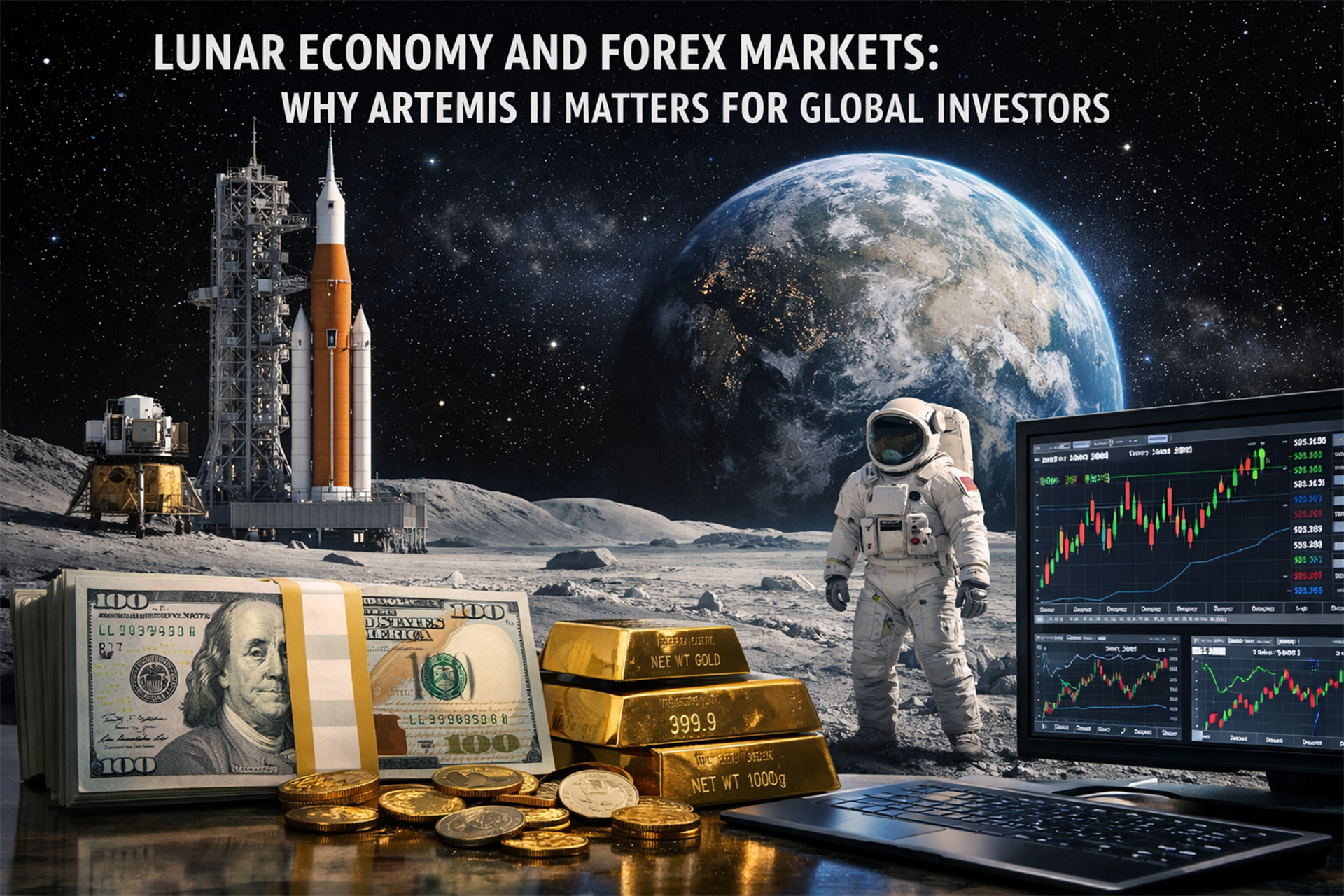
Lunar Economy and Forex Markets: Why Artemis II Matters for Global Investors
Lunar Resources and Commodity Market Implications
The real prize is not the Moon itself but what lies beneath its surface. Scientific estimates suggest the presence of water ice in permanently shadowed craters, particularly near the lunar south pole. This resource is critical because it can be converted into hydrogen and oxygen — the building blocks of rocket fuel.From a market standpoint, this introduces a new dimension to commodity trading. While lunar extraction is not immediately scalable, the anticipation of such capabilities influences long-term projections for energy markets. Analysts increasingly model scenarios where off-Earth resource production reduces dependence on terrestrial supply chains.
This has indirect implications for forex traders. Commodity-linked currencies such as the Canadian dollar or Australian dollar may face structural adjustments if future energy dynamics shift away from Earth-based extraction. At the same time, countries investing heavily in space infrastructure could see stronger capital inflows, supporting their currencies.
US–China Space Competition and Forex Volatility
Geopolitics remains a central factor. During the Apollo era, the United States competed with the Soviet Union. Today, the primary rival is China. The China National Space Administration has already conducted multiple lunar missions and publicly targets a crewed landing by 2030.Although the Outer Space Treaty of 1967 prohibits national ownership of celestial bodies, it does not prevent strategic positioning. Access to resource-rich regions and optimal landing zones effectively creates a new layer of geopolitical competition.
For forex markets, this competition introduces volatility drivers similar to those seen in trade wars or military tensions. When geopolitical uncertainty rises, safe-haven currencies such as the US dollar, Swiss franc, and Japanese yen typically strengthen. Artemis II, therefore, is not just a scientific milestone — it is a signal event in the broader geopolitical landscape.
Artemis II as a Precursor to Mars and Long-Term Investment Cycles
NASA has consistently framed the Moon as a testing ground for Mars. This is not a short-term narrative. It represents a multi-decade investment cycle involving infrastructure, robotics, and sustainable life-support technologies.From an investor’s perspective, such cycles are critical. They create predictable demand across industries and allow for long-term capital positioning. Similar to how renewable energy reshaped investment strategies over the past decade, space infrastructure is emerging as a new thematic trend.
Currency markets respond to these trends through capital flows. Regions that attract investment in advanced technologies tend to see currency appreciation over time. In this context, the Artemis program strengthens the long-term outlook for the US economy while also forcing competitors to accelerate their own investments.
What Forex Traders Should Watch in 2026–2028
The immediate impact of Artemis II on forex markets will likely be indirect but measurable. Key indicators include government spending on space programs, shifts in defense budgets, and increased private sector participation in aerospace.Data points to monitor include US federal spending on NASA programs, which is projected to exceed $93 billion cumulatively by the end of fiscal year 2025 (NASA Office of Inspector General, USA). Additionally, tracking Chinese space investments and European Space Agency initiatives provides a broader picture of global competition.
For traders, the practical takeaway is not to trade the mission itself but to understand the macro narrative it represents. Artemis II is part of a larger transition toward a space-driven economy, and markets tend to price in such transitions long before they fully materialize.
Artemis II is not about repeating history. It is about redefining it. The Moon is transitioning from a symbol of past achievements into a platform for future economic expansion. For financial markets, this shift introduces new variables — from geopolitical competition to long-term resource strategies.
Those who understand these signals early gain an advantage. In modern markets, the next frontier is not just digital or decentralized. It is orbital.
Those who understand these signals early gain an advantage. In modern markets, the next frontier is not just digital or decentralized. It is orbital.
By Claire Whitmore
March 31, 2026
Join us. Our Telegram: @forexturnkey
All to the point, no ads. A channel that doesn't tire you out, but pumps you up.
March 31, 2026
Join us. Our Telegram: @forexturnkey
All to the point, no ads. A channel that doesn't tire you out, but pumps you up.




Report
My comments