



CRM for MetaTrader Providers: How Relationship Automation Multiplies Trader Lifetime Value
CRM for MetaTrader Providers: How Relationship Automation Multiplies Trader Lifetime Value
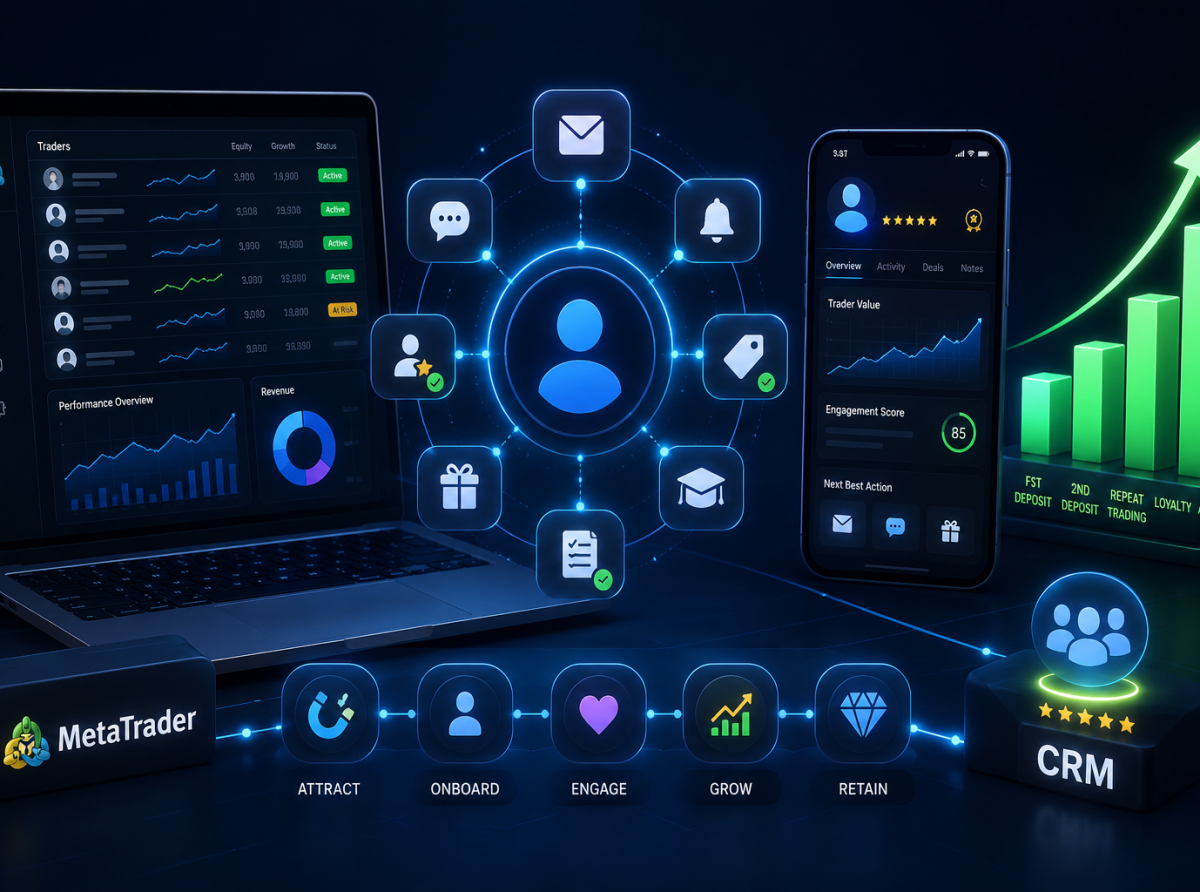
In 2026, the biggest profits in Forex no longer come only from acquiring new traders. They come from keeping traders active longer, increasing engagement and building ecosystems where users stay for years instead of weeks. This is why CRM systems became one of the most powerful growth engines for MetaTrader providers. Modern automation no longer simply manages contacts — it actively shapes trader behavior, loyalty and lifetime value.
The Forex industry quietly entered the retention era
For years, most brokers focused aggressively on acquisition.Affiliate traffic, bonus campaigns and paid advertising dominated growth strategies. But rising marketing costs and stronger competition fundamentally changed brokerage economics.
Today, acquiring a trader is expensive. Losing one is even more expensive.
This shift forced MetaTrader providers to rethink infrastructure priorities. Instead of treating CRM systems as secondary support tools, brokers increasingly view them as central profit-generation mechanisms.
The logic is simple: a trader who deposits once and disappears creates little long-term value. A trader who remains active for years becomes an ecosystem asset.
Lifetime value became the real metric that matters
Modern brokerage businesses increasingly operate like subscription ecosystems.The goal is not merely registration or first deposit conversion. The real objective is maximizing trader lifetime value through continuous engagement.
CRM automation directly influences that process.
Behavioral tracking, segmented communication and predictive analytics allow brokers to identify patterns long before users become inactive.
A trader reducing trading frequency, delaying deposits or withdrawing emotionally after losses leaves measurable signals inside CRM systems.
Advanced automation transforms those signals into retention actions.
That is where modern Forex competition increasingly happens — not on the landing page, but inside long-term relationship management.
Automation is replacing fragmented human workflows
Traditional brokerage operations relied heavily on manual management.Sales teams, support agents and account managers handled most communication individually. That model struggles under modern scale.
Large MetaTrader ecosystems now process enormous volumes of behavioral data across multiple regions, languages and trading styles simultaneously.
CRM automation became essential because humans alone cannot react fast enough.
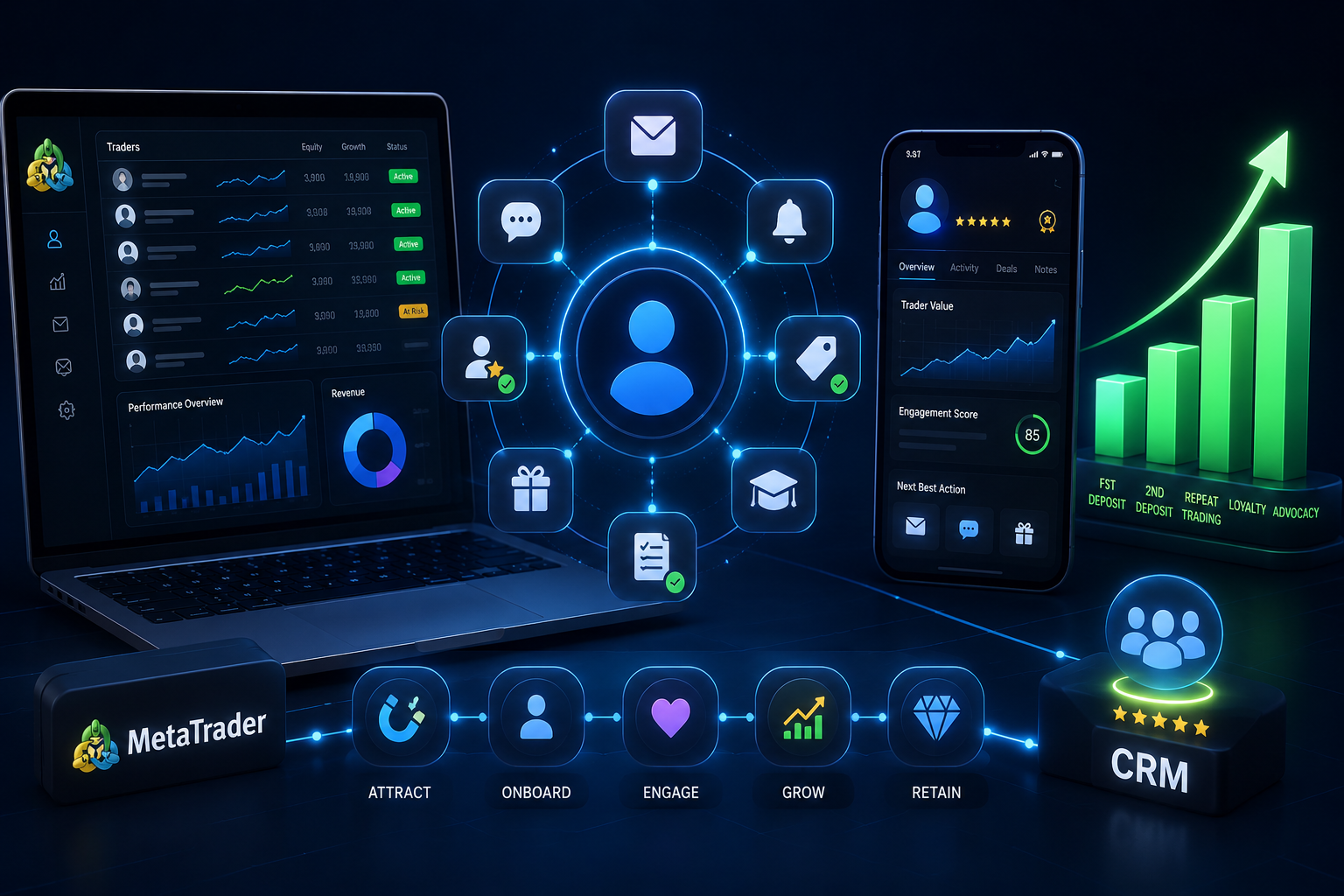
Modern systems automatically personalize communication flows, detect inactivity risks, trigger educational campaigns and segment traders based on behavior patterns in real time.
This reduces operational costs while improving consistency.
The result is scalable personalization.
CRM for MetaTrader Providers: How Relationship Automation Multiplies Trader Lifetime Value
Personalization became the new loyalty mechanism
Forex traders became more demanding psychologically.Many no longer respond to generic marketing emails or mass promotional campaigns. They expect tailored experiences, fast onboarding and relevant communication.
CRM systems increasingly provide that infrastructure.
Modern brokers personalize content based on trading activity, account size, risk profile, preferred instruments and even emotional behavior during volatility.
This creates a deeper sense of platform relevance.
The psychological effect matters enormously.
Traders who feel “understood” by a platform statistically remain engaged longer and generate higher lifetime value over time.
AI is transforming CRM into predictive infrastructure
Artificial intelligence accelerated this evolution dramatically.Modern CRM ecosystems increasingly use machine learning models to forecast trader churn probability, identify profitable client segments and optimize communication timing automatically.
Instead of reacting after users disappear, brokers now attempt to predict disengagement before it happens.
AI systems analyze trading frequency, platform activity, behavioral consistency and funding patterns to estimate retention risks in advance.
This transforms CRM from administrative software into predictive business infrastructure.
The Forex industry is quietly becoming data-driven at its core.
Prop firms accelerated CRM innovation
The explosive rise of prop trading firms created additional pressure for CRM sophistication.Prop firms operate in highly emotional environments where traders constantly face evaluation pressure, drawdown limits and psychological stress.
Under these conditions, retention becomes deeply connected to communication quality and emotional management.
CRM systems now help prop firms monitor engagement patterns, reduce dropout rates and maintain trader activity during difficult market periods.
The infrastructure increasingly resembles behavioral ecosystem management rather than traditional client support.
Compliance and regulation also drive automation
Another major factor behind CRM expansion is regulation.KYC, AML monitoring and international reporting requirements became far more complex across global brokerage markets.
Manual compliance operations create operational bottlenecks and increase risk exposure.
CRM systems increasingly integrate identity verification, transaction monitoring and compliance workflows into unified automated environments.
This reduces human error while improving scalability.
For many MetaTrader providers, CRM automation is no longer optional operational optimization — it is becoming a survival requirement.
The future broker behaves more like a technology platform
One of the most important long-term trends is structural.The strongest brokers increasingly resemble technology companies rather than traditional financial intermediaries.
Their competitive edge depends less on aggressive sales and more on infrastructure intelligence.
CRM systems sit at the center of that transformation.
They unify marketing, retention, analytics, compliance and behavioral optimization into one ecosystem.
The brokers growing fastest in 2026 are often not those spending the most on advertising, but those understanding trader behavior most effectively.
CRM systems became critical for MetaTrader providers because the Forex industry itself changed. Modern brokerage competition revolves around retention, behavioral intelligence and long-term ecosystem value rather than short-term acquisition alone. In 2026, automation is no longer replacing human relationships — it is scaling them. And for many brokers, the ability to intelligently manage trader engagement may become more important than spreads, leverage or even platform branding itself.
By Claire Whitmore
May 28, 2026
Join us. Our Telegram: @forexturnkey
All to the point, no ads. A channel that doesn't tire you out, but pumps you up.
May 28, 2026
Join us. Our Telegram: @forexturnkey
All to the point, no ads. A channel that doesn't tire you out, but pumps you up.




Report
My comments