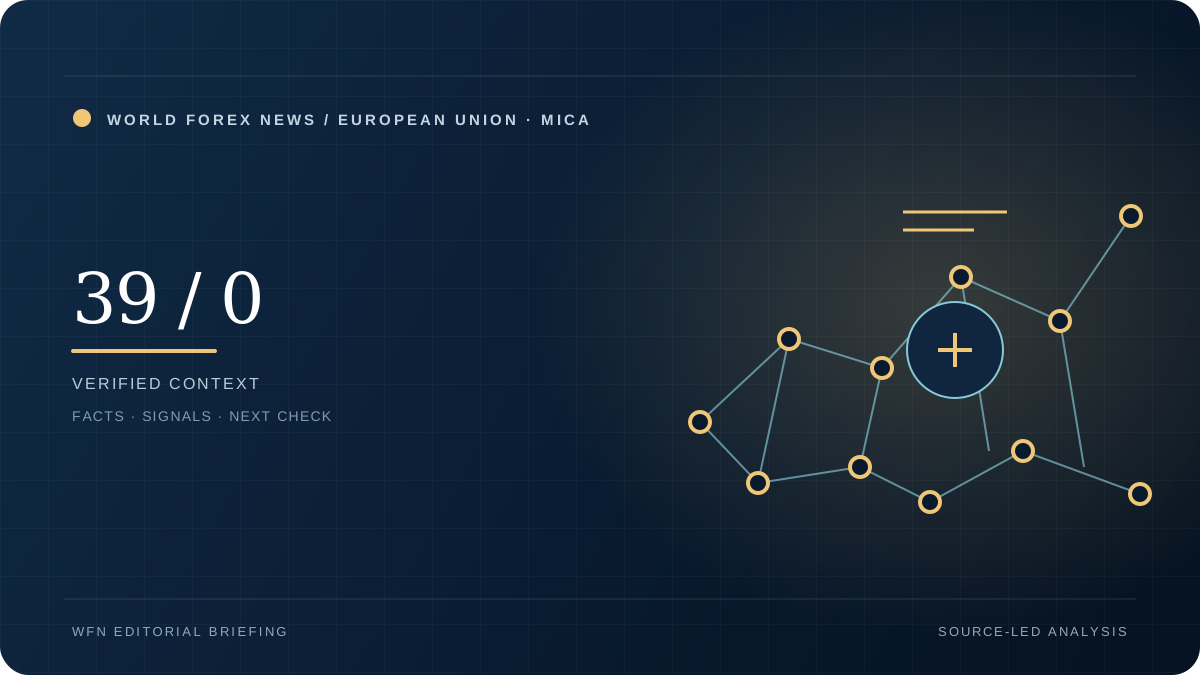
On 24 September the European Banking Authority published its response to the European Commission’s targeted consultation on reviewing MiCA. It highlighted multi-issuer stablecoin risks, classification boundaries and crypto lending as priorities. These are recommendations for the Commission’s review, not new obligations already in force. European Banking Authority: priorities for the MiCA review, 24 September 2026
Follow the evidence
Trace how the event could reach markets, then inspect a competing explanation.
Compare explanations
Switch lenses to see what each account explains—and what remains uncertain.
The EBA is directing attention toward cross-border stablecoin structures, classification and lending models.
The EBA is directing attention toward cross-border stablecoin structures, classification and lending models.
A consultation response informs policy, while the Commission and EU legislators decide whether and how to change the framework.
The authority has identified issues for the Commission to examine
The EBA’s response covers questions within its supervisory remit, including the boundary between MiCA and other EU financial-services legislation, requirements for asset-referenced and e-money tokens, multi-function groups, payment-services interactions and crypto lending. It asks the Commission to prioritise areas where evolving business models may create uncertainty or supervisory gaps. European Banking Authority: priorities for the MiCA review, 24 September 2026
The authority called for stronger treatment of risks from multi-issuer stablecoin arrangements and clearer classification rules to support consistency. It also recommended that crypto-asset borrowing and lending, including activity linked to decentralised finance, be considered in the review. These statements describe the EBA’s submitted policy recommendations, not requirements that exchanges or issuers must implement immediately. European Banking Authority: priorities for the MiCA review, 24 September 2026
As of 1 September 2026, the EBA used a reference count of 39 e-money tokens issued under MiCA and zero authorised asset-referenced tokens. The date is important: the figures are a snapshot for its consultation response, not a live register count. They also should not be read as evidence that no other tokens exist outside those authorisation categories. European Banking Authority: priorities for the MiCA review, 24 September 2026
Scope clarity could change how firms organise products and oversight
If the Commission proposes amendments, firms with multiple services may need to reassess how stablecoin issuance, trading, custody and payment features fit across MiCA, securities rules and payment legislation. The EBA’s response signals where supervisors see questions, but any concrete change depends on the Commission’s future position and the legislative process.
Multi-issuer structures raise questions about who holds the redemption obligation, how reserves are managed across jurisdictions and which authority can respond when one part of an arrangement is under stress. The EBA’s concern supports closer examination of the structure; it does not mean every multi-issuer design has the same risk profile. EBA response to the European Commission’s targeted consultation on MiCA review
For lending and DeFi, classification can turn on practical control, counterparties, repayment promises and service design. The EBA proposes considering these areas because current rules may not fit every model cleanly. A consultation response is one institutional input, so it should not be presented as consensus across all EU bodies or as a final legal interpretation.
Watch for a Commission proposal and the text behind it
The next milestone is the Commission’s assessment of consultation responses and any decision to propose amendments. Until a formal proposal appears, firms can use the EBA response as a map of likely discussion topics while continuing to comply with the current MiCA framework and applicable national rules.
A useful review separates recommendations from adopted technical standards, directly applicable law and supervisory guidance. Track the exact document, the legal article it concerns, and whether the EBA is describing an existing gap or suggesting a future change. This prevents a high-level headline from being mistaken for an immediate licensing or product deadline.
The EBA response also highlights the difficulty of counting a rapidly evolving market with static figures. Check the date of each register or status claim, then consult current supervisory registers before making business decisions. The 39 and zero figures remain meaningful for the EBA’s 1 September reference date but should not be silently carried forward. European Banking Authority: priorities for the MiCA review, 24 September 2026